
Introduction
Speciering is a fascinating concept in evolutionary biology that explains how new species develop over time. Although the term is less commonly used than speciation, it refers to the same biological process through which populations of living organisms gradually evolve into separate species. This natural phenomenon has played a crucial role in creating the incredible diversity of plants, animals, fungi, and microorganisms found across the globe.
Understanding speciering helps scientists explain why different organisms exist, how they adapt to changing environments, and why biodiversity continues to evolve. From the colorful birds of the Galápagos Islands to unique fish in African lakes, countless examples demonstrate this remarkable process in action.
In this comprehensive guide, you’ll discover what speciering means, how it works, its different types, real-world examples, factors influencing it, scientific importance, common misconceptions, and frequently asked questions.
What Is Speciering?
Definition of Speciering
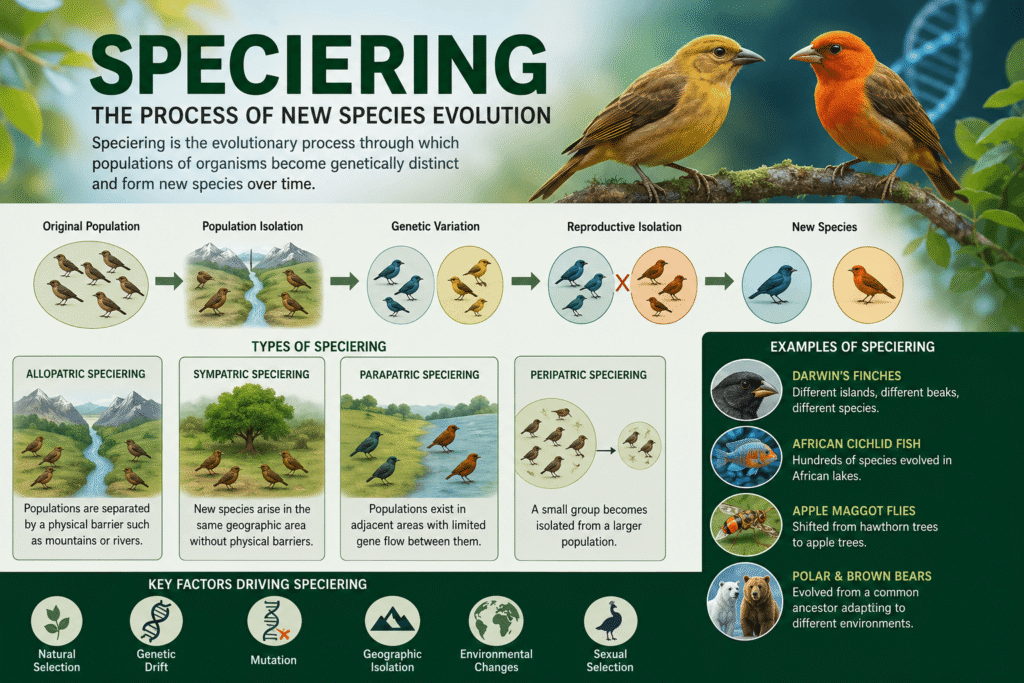
Speciering is the evolutionary process through which one ancestral population gradually divides into two or more genetically distinct species. This transformation occurs over many generations as populations accumulate genetic differences that eventually prevent them from interbreeding successfully.
In simple words, speciering explains how life continues to diversify naturally through evolution.
Scientists often use the term speciation, but speciering is occasionally used in educational discussions to describe the same biological concept.
Why Speciering Is Important
Understanding speciering is essential because it explains the origin of Earth’s biodiversity.
Without this evolutionary process:
- Millions of species would never have existed.
- Ecosystems would be far less diverse.
- Evolution would eventually stop.
- Organisms could struggle to adapt to environmental changes.
Researchers use studies of speciering to understand evolution, conservation biology, genetics, ecology, medicine, and environmental science.
How Speciering Happens
The Evolutionary Process Behind Speciering
The development of new species usually occurs gradually rather than instantly.
The general process includes several stages:
Genetic Variation
Every population contains small genetic differences among individuals. These variations arise through mutations and genetic recombination.
Isolation
A population becomes divided due to geographical barriers, behavioral changes, or ecological differences.
Natural Selection
Each isolated population experiences different environmental pressures, causing advantageous traits to become more common over generations.
Genetic Divergence
As generations pass, the separated populations accumulate enough genetic differences that they can no longer reproduce successfully together.
Formation of New Species
Eventually, reproductive isolation becomes permanent, resulting in entirely new species.
Types of Speciering
Scientists recognize several major forms of speciering based on how populations become separated.
Allopatric Speciering
Allopatric speciering occurs when populations become physically separated by geographical barriers such as:
- Mountains
- Rivers
- Oceans
- Deserts
- Glaciers
Because the populations no longer exchange genes, they evolve independently.
Example
Darwin’s finches on the Galápagos Islands evolved into numerous distinct species after becoming isolated on different islands.
Sympatric Speciering
Unlike geographical isolation, sympatric speciering happens when populations remain in the same location but develop reproductive barriers.
This may occur because of:
- Different mating behaviors
- Chromosome changes
- Dietary specialization
- Habitat preferences
Plants commonly experience sympatric speciering through chromosome duplication.
Parapatric Speciering
Parapatric speciering develops when neighboring populations occupy different environments with only limited interaction.
Although some gene flow continues, natural selection favors different characteristics in each environment until new species emerge.
Peripatric Speciering
Peripatric speciering involves a small group becoming isolated from a much larger population.
Since the isolated population contains only a small genetic sample, evolution may occur rapidly through genetic drift and natural selection.
Mechanisms That Drive Speciering
Several biological mechanisms contribute to the formation of new species.
Natural Selection
Natural selection favors traits that improve survival and reproduction.
Individuals possessing beneficial characteristics leave more offspring, gradually changing the genetic makeup of the population.
Genetic Drift
Random changes in gene frequencies can significantly affect small populations.
Over many generations, these random events may produce substantial genetic differences.
Mutation
Mutations introduce entirely new genetic variations.
While many mutations have little effect, some provide advantages that become widespread within populations.
Gene Flow
Gene flow refers to the movement of genes between populations.
Reduced gene flow allows isolated groups to evolve independently, increasing the likelihood of speciering.
Sexual Selection
Mate choice also influences evolution.
If individuals consistently prefer partners with specific traits, reproductive isolation may eventually develop.
Real-Life Examples of Speciering
Numerous examples illustrate how new species evolve.
Darwin’s Finches
Perhaps the most famous example involves Darwin’s finches.
Different islands provided unique food sources, causing beak shapes to evolve differently over thousands of years.
Today, multiple distinct finch species occupy the islands.
African Cichlid Fish
African Great Lakes contain hundreds of cichlid fish species.
Differences in feeding habits, habitat preferences, and mating behaviors contributed to their remarkable diversity.
Polar Bears and Brown Bears
Scientists believe polar bears evolved from brown bear ancestors after adapting to Arctic environments.
Changes in diet, climate, and habitat gradually produced distinct species.
Apple Maggot Flies
These insects originally reproduced on hawthorn trees.
Some populations later adapted to apple trees, eventually becoming reproductively isolated despite living in the same region.
Factors That Influence Speciering
Many environmental and biological factors affect the rate of species formation.
Climate Change
Changing climates force populations into new environments where different evolutionary pressures occur.
Geographic Isolation
Physical barriers remain one of the strongest drivers of evolutionary divergence.
Ecological Niches
When populations occupy different ecological roles, they experience unique selective pressures.
Population Size
Small populations often evolve more rapidly because genetic drift has stronger effects.
Time
Speciering usually requires thousands or even millions of years, although certain organisms evolve more quickly.
Speciering and Biodiversity
The Earth’s extraordinary biodiversity exists largely because of continuous speciering.
Every ecosystem contains species that evolved from common ancestors through gradual evolutionary changes.
Examples include:
- Tropical rainforests
- Coral reefs
- Grasslands
- Arctic ecosystems
- Mountain forests
Without ongoing species formation, biodiversity would eventually decline.
Modern Research on Speciering
Scientists now study speciering using advanced technologies.
Modern research includes:
DNA Sequencing
Genetic analysis reveals relationships among species with remarkable accuracy.
Fossil Evidence
Fossils document transitional forms that help reconstruct evolutionary history.
Computer Modeling
Researchers simulate evolutionary processes to understand how populations diverge.
Field Studies
Long-term observations of wild populations continue providing valuable insights into species formation.
Common Misconceptions About Speciering
Many misunderstandings surround evolutionary biology.
Misconception 1: New Species Appear Overnight
Reality: Species formation usually takes many generations.
Misconception 2: Evolution Always Moves Toward Perfection
Reality: Evolution simply favors traits that improve reproductive success under current conditions.
Misconception 3: Humans No Longer Evolve
Reality: Human populations continue experiencing evolutionary changes.
Misconception 4: Every Isolated Population Becomes a New Species
Reality: Isolation alone is not enough. Genetic differences must eventually create reproductive barriers.
Challenges in Studying Speciering
Although evolutionary biology has advanced significantly, studying new species remains challenging.
Scientists must overcome issues such as:
- Limited fossil records
- Long evolutionary timescales
- Complex genetic interactions
- Environmental variability
- Hybrid populations
Despite these difficulties, modern genetics has greatly improved scientific understanding.
Future of Speciering Research
Researchers continue discovering new insights into evolutionary biology.
Future studies will likely focus on:
- Artificial intelligence in genetics
- Whole-genome sequencing
- Climate-driven evolution
- Conservation biology
- Microbial evolution
- Evolutionary medicine
These discoveries will help scientists better understand life’s remarkable diversity.
Why Understanding Speciering Matters Today
Learning about speciering benefits more than biology students.
It helps society:
- Protect endangered species.
- Preserve ecosystems.
- Improve conservation strategies.
- Understand disease evolution.
- Develop sustainable environmental policies.
- Appreciate Earth’s biological diversity.
Knowledge of evolutionary processes also strengthens scientific literacy and promotes informed environmental decision-making.
Conclusion
Speciering represents one of nature’s most extraordinary evolutionary processes. Through genetic variation, natural selection, isolation, mutation, and environmental adaptation, populations gradually develop into entirely new species. This ongoing process has shaped Earth’s biodiversity for millions of years and continues today.
From Darwin’s finches to African cichlids and countless other organisms, evidence consistently demonstrates how evolution produces new forms of life. As modern genetic research expands our understanding, scientists continue uncovering the remarkable mechanisms responsible for species formation.
Whether studied from the perspective of biology, ecology, genetics, or conservation, speciering remains a cornerstone of evolutionary science and an essential concept for understanding the history and future of life on Earth.
Frequently Asked Questions (FAQs)
What does speciering mean?
Speciering refers to the evolutionary process in which new species develop from existing populations through genetic divergence and reproductive isolation.
Is speciering the same as speciation?
Yes. Speciering is another term used to describe the biological process more commonly known as speciation.
What is the most common type of speciering?
Allopatric speciering is considered the most common because geographic isolation frequently separates populations.
How long does speciering take?
The process may require thousands to millions of years, depending on environmental conditions, population size, and genetic changes.
Why is speciering important?
Speciering explains the origin of biodiversity, helps scientists understand evolution, supports conservation efforts, and reveals how organisms adapt to changing environments.