
Introduction
Every successful business starts with one essential element: understanding the market. Whether you are launching a startup, expanding an existing company, or introducing a new product, making decisions based on facts instead of assumptions can significantly improve your chances of success. This is where market research methods become valuable. They help businesses gather reliable information about customers, competitors, industry trends, and market opportunities.
Research is no longer limited to large corporations. Small businesses, entrepreneurs, marketers, and even content creators use different research techniques to understand consumer behavior and make smarter business decisions. With the right approach, companies can reduce risks, identify customer needs, improve products, and create more effective marketing campaigns.
This comprehensive guide explains the different types of market research, popular techniques, advantages, challenges, and best practices for achieving reliable results.
What Are Market Research Methods?
Market research methods are systematic techniques used to collect, analyze, and interpret information about a target market. These methods help organizations understand customer preferences, buying behavior, industry trends, pricing strategies, and competitor activities.
The information collected enables businesses to make informed decisions rather than relying on guesswork. Good research reduces uncertainty and provides valuable insights that support business growth.
Some businesses conduct research before launching a product, while others perform continuous research to monitor changing customer preferences and market conditions.
Why Are Market Research Methods Important?
Every business operates in a competitive environment. Understanding customers and market dynamics offers several advantages.
Better Customer Understanding
Research helps businesses identify customer needs, preferences, challenges, and expectations.
Reduced Business Risk
Launching products without proper research can be expensive. Research minimizes uncertainty and helps companies avoid costly mistakes.
Improved Marketing Strategy
Knowing what customers want allows businesses to create targeted advertising campaigns that generate better results.
Competitive Advantage
Studying competitors helps businesses identify market gaps and opportunities that others may overlook.
Product Development
Customer feedback provides valuable information for improving existing products or creating new ones.
Types of Market Research Methods
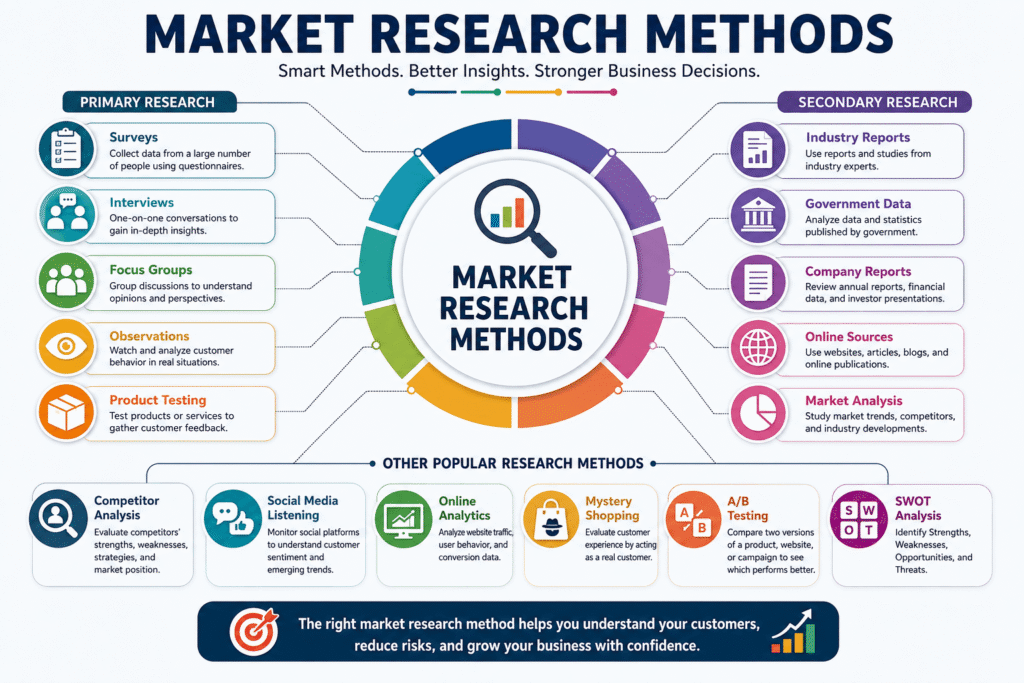
Research techniques generally fall into two major categories.
Primary Research
Primary research involves collecting original data directly from customers or potential buyers. Since the information comes directly from the source, it is usually more accurate and relevant.
Common examples include:
- Customer surveys
- Interviews
- Focus groups
- Observation studies
- Product testing
- Questionnaires
Primary research is especially useful when businesses need specific information that cannot be found elsewhere.
Secondary Research
Secondary research involves analyzing information already collected by other organizations.
Examples include:
- Industry reports
- Government publications
- Business journals
- Academic studies
- Company reports
- Trade publications
Secondary research is generally faster and more affordable than primary research. It also provides useful background information before conducting original studies.
Qualitative Market Research Methods
Qualitative research focuses on understanding opinions, emotions, motivations, and experiences.
Instead of collecting numbers, it explores why customers think or behave in certain ways.
Customer Interviews
One-on-one interviews allow researchers to ask detailed questions and explore customer opinions in depth.
Advantages include:
- Detailed responses
- Better understanding of customer emotions
- Flexible conversation
However, interviews require time and skilled interviewers.
Focus Groups
Focus groups bring together a small number of participants to discuss products, services, or ideas.
Benefits include:
- Immediate feedback
- Multiple viewpoints
- Rich discussions
- Discovery of hidden customer concerns
Businesses often use focus groups before launching new products.
Observation Research
Instead of asking customers questions, researchers observe how people interact with products or services.
Observation can reveal behaviors customers may not mention during interviews.
Retail stores frequently use this technique to study shopping habits.
Quantitative Market Research Methods
Quantitative research collects numerical information that can be measured and analyzed statistically.
This type of research answers questions such as:
- How many customers prefer a product?
- What percentage of people are satisfied?
- Which age group buys the most?
Online Surveys
Online surveys are among the most widely used research techniques today.
Businesses can quickly gather responses from hundreds or even thousands of participants.
Advantages include:
- Low cost
- Fast data collection
- Easy analysis
- Large sample sizes
Well-designed surveys provide valuable insights into customer satisfaction and buying behavior.
Polls
Polls ask simple questions with limited answer choices.
They are ideal for measuring public opinion on specific topics.
Many organizations conduct polls through websites, email campaigns, or social media platforms.
Statistical Analysis
After collecting data, businesses analyze the results using statistical tools.
Common measurements include:
- Average ratings
- Customer satisfaction scores
- Purchase frequency
- Brand awareness
- Conversion rates
These insights support better strategic planning.
Common Market Research Methods Used by Businesses
Customer Surveys
Surveys remain one of the most popular ways to gather customer opinions.
Questions may cover:
- Product quality
- Pricing
- Customer service
- Shopping experience
- Future expectations
Competitor Analysis
Studying competitors helps businesses understand:
- Pricing strategies
- Marketing approaches
- Product offerings
- Customer reviews
- Market positioning
Learning from competitors can reveal opportunities for improvement.
Social Media Research
Millions of customers share opinions online every day.
Businesses monitor social conversations to understand:
- Customer sentiment
- Brand reputation
- Emerging trends
- Consumer preferences
This provides valuable real-time feedback.
Product Testing
Before launching a new product, businesses often test prototypes with selected customers.
Product testing helps identify:
- Design improvements
- Performance issues
- Customer satisfaction
- Pricing acceptance
This reduces the risk of product failure.
Website Analytics
Digital businesses analyze website data to understand customer behavior.
Important metrics include:
- Visitor numbers
- Bounce rate
- Time spent on pages
- Purchase behavior
- Traffic sources
Analytics reveal how customers interact with online content.
Steps for Conducting Effective Market Research
Define Your Objective
Start by identifying the exact question you want to answer.
Examples include:
- Is there demand for a new product?
- Who is the target audience?
- What price should be charged?
Clear objectives improve research accuracy.
Identify Your Target Audience
Choose participants who represent your ideal customers.
Factors may include:
- Age
- Gender
- Income
- Location
- Interests
- Buying habits
Choose the Appropriate Research Method
Select the method that best matches your objective.
For example:
- Interviews for detailed opinions
- Surveys for numerical data
- Observation for customer behavior
- Secondary research for industry information
Collect Reliable Data
Use unbiased questions and collect responses from enough participants to ensure reliable results.
Accurate data leads to better business decisions.
Analyze Results
Organize the information and identify patterns, trends, and opportunities.
Modern software can simplify data analysis and visualization.
Take Action
Research has value only when businesses apply the findings.
Use the results to improve products, marketing campaigns, pricing strategies, and customer experiences.
Advantages of Market Research Methods
Businesses gain several benefits from conducting regular research.
These include:
- Better understanding of customer needs
- Stronger competitive positioning
- Increased customer satisfaction
- Improved marketing performance
- Smarter investment decisions
- Reduced business risks
- More successful product launches
- Higher profitability
- Better brand positioning
- Long-term business growth
Challenges of Market Research
Despite its benefits, research also presents challenges.
Common difficulties include:
- High costs for large studies
- Time-consuming data collection
- Biased survey responses
- Changing consumer behavior
- Limited sample sizes
- Difficulty interpreting complex data
Businesses should carefully design research projects to minimize these issues.
Best Practices for Successful Market Research
Set Clear Goals
Know exactly what information you need before starting.
Ask Neutral Questions
Avoid leading questions that influence participant responses.
Use Multiple Techniques
Combining interviews, surveys, and analytics provides more complete insights.
Keep Research Updated
Markets change constantly. Regular research ensures businesses stay informed.
Protect Customer Privacy
Collect and store data responsibly while respecting participant confidentiality.
Future Trends in Market Research
Technology continues to transform research practices.
Emerging trends include:
Artificial Intelligence
AI helps analyze large datasets faster and identify hidden patterns.
Predictive Analytics
Businesses use historical data to forecast future customer behavior.
Mobile Research
More surveys and interviews are conducted through smartphones.
Real-Time Data Collection
Organizations increasingly monitor customer feedback as it happens.
Big Data Analysis
Large datasets provide deeper insights into consumer preferences and market trends.
These innovations are making research faster, more accurate, and more valuable.
Conclusion
Understanding customers is one of the most important factors behind business success. By using effective market research methods, organizations can make informed decisions, identify growth opportunities, improve products, and strengthen customer relationships. Whether using interviews, surveys, observation, competitor analysis, or digital analytics, every research technique contributes valuable insights that support better planning and long-term success.
Businesses that consistently invest in quality research are better equipped to adapt to changing market conditions, meet customer expectations, and maintain a competitive advantage. In today’s fast-changing business environment, market research is no longer optional—it is a critical foundation for sustainable growth.