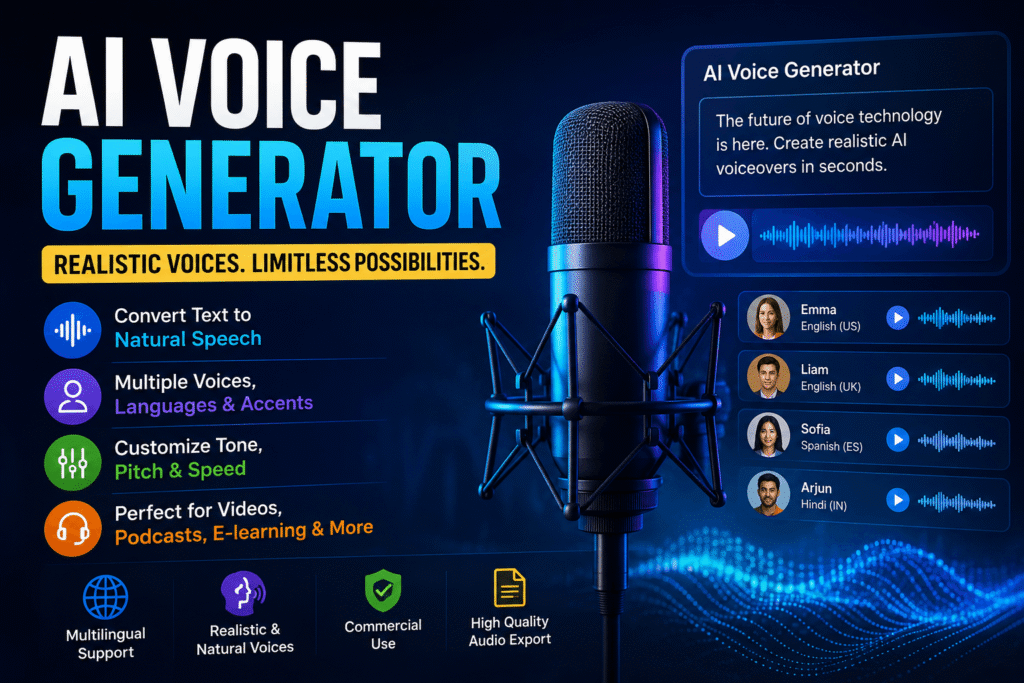

An AI Voice Generator has changed the way people create voiceovers, narrations, podcasts, advertisements, educational content, and social media videos. Instead of hiring a professional voice actor or recording audio manually, users can now convert written text into natural-sounding speech within minutes.
Modern voice technology has moved far beyond the robotic computer voices of the past. Artificial intelligence can now produce speech with different accents, tones, languages, emotions, and speaking styles. For content creators, businesses, educators, developers, and marketers, these tools can save both time and production costs.
What Is an AI Voice Generator?
An AI Voice Generator is a software tool that uses artificial intelligence, machine learning, and speech-synthesis technology to transform written text into spoken audio. The user generally enters a script, selects a voice, adjusts available settings, and generates an audio file.
Traditional text-to-speech systems often sounded mechanical because they followed predefined pronunciation rules. Modern AI systems learn from large amounts of speech data, allowing them to understand pronunciation, rhythm, pauses, emphasis, and other characteristics of natural conversation.
How AI Voice Generation Works
The process usually begins when a user enters written content into the platform. The AI analyzes the text to understand words, sentences, punctuation, and context. A speech model then converts that information into an audio waveform.
Advanced systems can also control characteristics such as speed, pitch, pronunciation, emphasis, and emotional delivery. Some platforms provide additional voice-design features that allow users to create voices suited to specific projects.
Why AI Voices Sound More Natural
Natural speech is not simply a collection of correctly pronounced words. Human speakers change their pace, pitch, volume, and pauses depending on the meaning of a sentence.
Modern voice models attempt to reproduce these patterns. As a result, high-quality synthetic voices can sound conversational rather than purely computerized.
Best Uses of an AI Voice Generator
The technology has applications across many industries. It is particularly useful when people need consistent voice production without repeatedly recording the same material.
AI Voice Generator for YouTube Videos
YouTube creators can use generated narration for tutorials, documentaries, explainers, educational videos, product reviews, and other formats. A creator can prepare a script and generate narration without setting up a microphone or recording studio.
This can be especially useful for creators who publish frequently and need a consistent voice across multiple videos.
Voiceovers for Marketing and Advertising
Businesses can create narration for promotional videos, product demonstrations, social media advertisements, presentations, and digital campaigns. AI-generated speech makes it easier to produce several versions of the same advertisement for different markets.
Podcasts and Audiobooks
Podcast producers can use synthetic voices for introductions, explanations, summaries, and certain scripted formats. Audiobook production can also benefit from AI narration, particularly for projects that require large amounts of spoken content.
However, professional projects should consider whether the chosen voice and licensing terms are appropriate for commercial distribution.
Education and E-Learning
Teachers, training companies, and educational platforms can turn written lessons into spoken material. This can make courses more accessible to learners who prefer listening rather than reading.
Generated narration can also be useful for language-learning exercises, pronunciation practice, and educational presentations.
Important Features to Look For
Not every AI voice platform provides the same capabilities. Before choosing a tool, users should consider several important features.
Natural-Sounding Speech
Voice quality should be one of the first considerations. A good system should produce clear pronunciation, appropriate pauses, and natural pacing.
Listen to sample outputs before selecting a platform, especially if the audio will be used for professional content.
Multiple Languages and Accents
If you create international content, multilingual support can be extremely valuable. Some platforms provide voices across numerous languages and regional accents.
This allows businesses to adapt content for different audiences without creating completely separate production workflows.
Voice Customization
Advanced platforms may allow users to adjust speaking speed, pitch, tone, pauses, emphasis, or pronunciation. Greater control can make generated narration sound more appropriate for a particular audience.
Voice Cloning
Voice cloning allows AI systems to create a synthetic voice based on recordings of a real speaker. This can be useful for authorized personal or business applications, such as maintaining a consistent narrator voice.
Because voice recordings can represent a person’s identity, responsible platforms generally require appropriate permission or authorization. Users should never clone another person’s voice for deception, fraud, or impersonation.
Audio Export Options
Check whether the platform supports common audio formats and provides suitable quality for your intended project. Professional video editors may require specific formats or settings.
How to Choose the Best AI Voice Generator
The best tool depends on your purpose rather than simply choosing the platform with the largest number of voices.
For Content Creators
YouTube creators and social media professionals should prioritize natural narration, quick generation, voice consistency, and easy export.
For Businesses
Companies should focus on commercial usage rights, pronunciation control, multilingual capabilities, privacy, and reliable production.
For Developers
Developers may need an API, low latency, scalable pricing, and integration options. Real-time applications such as virtual assistants, interactive characters, and customer-service systems may require particularly fast speech generation.
For Beginners
New users should look for a simple interface, clear pricing, useful free options, and straightforward editing tools. An overly complicated platform can make a basic voiceover unnecessarily difficult to produce.
AI Voice Generator vs. Traditional Voice Recording
Traditional voice recording still has important advantages. A professional voice actor can deliver highly specific emotions, character performances, and creative interpretations.
However, AI voice technology offers speed, scalability, and consistency. A script can be changed and regenerated without arranging another recording session.
The choice depends on the project. A personal documentary, commercial campaign, fictional character, or corporate training course may each require a different approach.
Advantages of AI Voice Technology
Saves Time
Generating speech can take significantly less time than recording, editing, cleaning, and producing a traditional voiceover.
Reduces Production Costs
For certain projects, AI narration can reduce the need for studio equipment and repeated recording sessions.
Supports Global Content
Multilingual voices make it easier to adapt content for audiences in different countries and regions.
Provides Consistency
A synthetic narrator can maintain a similar voice across numerous videos, lessons, advertisements, or other projects.
Limitations and Challenges
Despite rapid improvements, AI-generated speech is not perfect.
Some voices may still struggle with unusual names, technical terminology, abbreviations, complex punctuation, or highly emotional performances. Certain outputs can also contain unnatural pauses or pronunciation errors.
Another concern is ethical use. Voice cloning technology can potentially be misused for impersonation, scams, misinformation, or unauthorized commercial content. Users should always obtain permission when working with someone’s recognizable voice.
Copyright, licensing, privacy, and commercial-use rules can also differ between platforms. Reading the terms before publishing generated audio is therefore important.
The Future of AI Voice Generators
The technology is expected to become increasingly expressive and interactive. Future systems may offer better emotional understanding, improved conversational timing, stronger multilingual performance, and more realistic character voices.
Real-time applications are another important area. AI voices can power virtual assistants, games, customer-service applications, accessibility tools, and interactive digital experiences.
As models improve, the difference between professionally recorded speech and synthetic narration may become increasingly difficult to recognize in many everyday applications.
How to Create Better AI Voiceovers
The quality of the final audio depends not only on the voice model but also on the script.
Write for Spoken Language
Use short, clear sentences and natural expressions. Written content designed for reading may not automatically sound good when spoken aloud.
Add Punctuation Carefully
Commas, periods, and other punctuation can influence pauses and rhythm. Proper formatting can make narration easier to understand.
Test Difficult Words
Names, abbreviations, numbers, and technical terms should be checked carefully. If pronunciation is incorrect, use available pronunciation controls or rewrite the phrase.
Review Before Publishing
Always listen to the complete recording before using it publicly. Check pronunciation, pacing, volume, unwanted pauses, and overall clarity.
Frequently Asked Questions
Is an AI Voice Generator free?
Some platforms provide free plans or limited credits, while advanced features may require a paid subscription. Pricing and usage limits vary by provider.
Can AI voices sound like real people?
Yes. Modern systems can produce highly realistic speech. Some also offer authorized voice-cloning capabilities.
Can I use AI voices for YouTube?
AI narration can be used for YouTube content, but creators should review the platform’s rules and the voice provider’s licensing terms before publishing commercially.
Is AI voice technology safe?
The technology itself can be used safely for legitimate purposes. The main risks involve unauthorized voice cloning, impersonation, privacy violations, and deceptive content.
What is the best AI Voice Generator?
There is no single option that is best for everyone. The right choice depends on voice quality, languages, customization, pricing, licensing, export options, and the type of content you want to create.
Final Thoughts
An AI Voice Generator has become a practical solution for producing professional-sounding narration quickly and efficiently. From YouTube videos and podcasts to education, marketing, accessibility, and software applications, AI-generated speech can support a wide range of creative and business needs.
The most important factor is choosing technology that matches your project. Look for natural voices, useful customization, reliable pronunciation, appropriate licensing, and responsible voice-use policies. When combined with a well-written script and careful editing, modern AI speech can deliver impressive results while making voice production faster and more accessible.