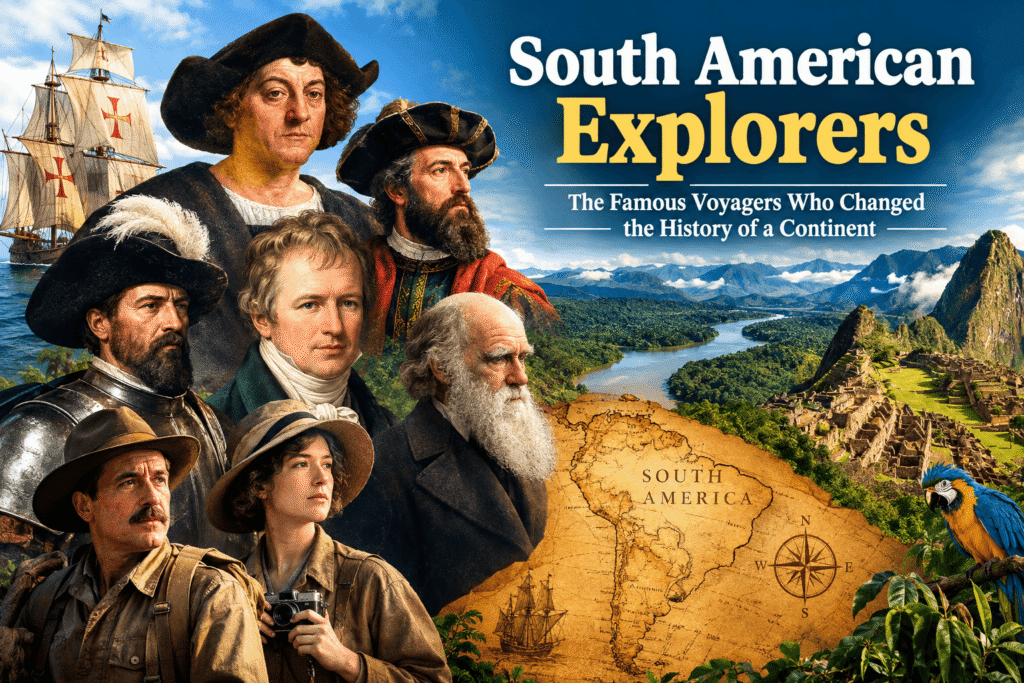

South America has a fascinating history of exploration shaped by Indigenous peoples, European navigators, conquistadors, scientists, cartographers, and adventurers. Long before European ships arrived, Indigenous societies had developed detailed knowledge of rivers, mountains, forests, coastlines, plants, animals, and travel routes across the continent. European exploration beginning in the late 15th century brought a new era of mapping and overseas expansion, but it also resulted in conquest, disease, colonization, and enormous changes for Indigenous communities. (Research Guides)
The history of south american explorers therefore involves much more than famous names and exciting journeys. It includes the search for trade routes and wealth, scientific discovery, geographical mapping, and encounters between very different cultures.
Who Were the South American Explorers?
The term south american explorers can refer to people who traveled through or mapped South America during different periods. Some were European sailors searching for new routes, while others were military expedition leaders, naturalists, surveyors, and adventurers.
During the European Age of Exploration, Spain and Portugal sponsored many voyages. Their objectives included finding trade routes, expanding political influence, spreading Christianity, and locating valuable resources. The Library of Congress notes that European exploration was encouraged by developments in navigation, shipbuilding, commerce, and the search for new markets and commodities. (Library of Congress)
Indigenous Knowledge Came First
It is important to understand that South America was not an unknown wilderness waiting to be discovered. Millions of Indigenous people lived throughout the Americas before European arrival, with sophisticated societies, agriculture, languages, political systems, and geographic knowledge. (Library of Congress)
Indigenous guides frequently provided European expeditions with information about rivers, mountain passes, food sources, settlements, and local geography. Their contributions were often essential to the success of later expeditions.
Christopher Columbus and South America
Christopher Columbus is one of the best-known figures connected with European exploration of the Americas. Although his first voyage in 1492 reached the Caribbean rather than South America, his later voyages took him to the mainland.
During his third voyage in 1498, Columbus reached the northern coast of South America near the Orinoco region. His voyages helped encourage further Spanish exploration and settlement.
Columbus’s Historical Impact
Columbus’s voyages had consequences far beyond geography. They opened the way for sustained European contact, colonization, and conquest. Indigenous populations suffered devastating effects from warfare, forced labor, displacement, and diseases introduced by Europeans. The Library of Congress documents the dramatic consequences of European-Indigenous encounters, including the severe population decline experienced by Caribbean Indigenous communities. (Library of Congress)
Amerigo Vespucci and the New World
Amerigo Vespucci was another important figure in early exploration. He participated in voyages along parts of the South American coastline and became associated with the idea that the lands Europeans were encountering were not simply the eastern edge of Asia.
His name eventually became attached to the continents of North and South America. In 1507, German cartographer Martin Waldseemüller used the name “America” on a famous map in recognition of Vespucci’s accounts and his identification of the lands as a separate “New World.” (Library of Congress)
Why Amerigo Vespucci Matters
Vespucci’s importance lies partly in how European geographical understanding changed. Early explorers initially interpreted their discoveries through the geographical knowledge of their time. As additional voyages produced new information, maps gradually became more accurate and the scale of the Americas became clearer.
Pedro Álvares Cabral and Brazil
Portuguese explorer Pedro Álvares Cabral is traditionally credited with reaching the coast of present-day Brazil in 1500 while leading a Portuguese expedition sailing toward India.
His arrival was significant because Portugal subsequently developed a major colonial presence in Brazil. The division of overseas territories between Spain and Portugal was influenced by the Treaty of Tordesillas of 1494, which established a line dividing their claimed areas of exploration and expansion. (Wikisource)
Portuguese Exploration
Portuguese exploration of South America focused particularly on Brazil’s extensive coastline. Over time, Portuguese settlements expanded inland, while explorers, missionaries, settlers, and military forces traveled farther into the continent.
Francisco Pizarro and the Andes
Francisco Pizarro became one of the most consequential Spanish expedition leaders in South America. He participated in expeditions along the Pacific coast and eventually led the Spanish conquest of the Inca Empire.
Pizarro’s campaigns brought Spanish forces into direct conflict with one of the most powerful states in pre-Columbian South America. The conquest dramatically changed the political and economic structure of the Andes.
The Library of Congress identifies Pizarro among the Spanish figures involved in the exploration and conquest of South America during the 16th century. (Library of Congress)
The Legacy of Pizarro
Pizarro’s story demonstrates that exploration and conquest were often closely connected during this period. European expeditions were not simply scientific journeys. They could involve military campaigns, territorial claims, resource extraction, and the establishment of colonial governments.
Francisco de Orellana and the Amazon River
Francisco de Orellana is one of the most famous explorers associated with the Amazon. In the 1540s, he traveled from the Andes toward the Amazon basin and eventually navigated a huge portion of the Amazon River system.
His expedition demonstrated the enormous scale and interconnectedness of the Amazon waterways to Europeans.
Exploring the Amazon
The Amazon presented extraordinary challenges. Dense rainforest, powerful rivers, unfamiliar climates, difficult terrain, and limited European knowledge made travel extremely dangerous.
Orellana’s journey became an important episode in the European exploration of the interior of South America. His expedition was also connected to European searches for the legendary wealth associated with El Dorado. (Wikisource)
The Search for El Dorado
One of the most persistent motivations behind South American expeditions was the legend of El Dorado.
European stories described a wealthy ruler or region supposedly associated with enormous quantities of gold. The legend changed over time and was placed on different maps and in different regions.
Numerous expeditions searched for this legendary source of wealth. Although the mythical golden kingdom was never found, the searches pushed explorers into remote areas of the continent.
Why El Dorado Became Famous
El Dorado illustrates how myths influenced geographical exploration. Rumors, incomplete maps, Indigenous stories, and European expectations could combine to create powerful legends that motivated dangerous expeditions.
Alexander von Humboldt: Explorer and Scientist
Not every important explorer traveled primarily for conquest or wealth. Alexander von Humboldt represented a different era of exploration.
Between 1799 and 1804, Humboldt and botanist Aimé Bonpland traveled through parts of South and Central America, collecting plant specimens and studying geography, geology, climate, and wildlife. (Library of Congress)
Humboldt’s Scientific Contributions
Humboldt helped establish a more scientific approach to exploration. Rather than simply claiming territory, he carefully recorded natural environments and relationships between climate, elevation, vegetation, and geography.
His observations influenced scientific thinking in Europe and North America and contributed greatly to knowledge about Latin America’s natural environment.
Charles Darwin’s South American Journey
Charles Darwin also became an important scientific explorer through his voyage aboard HMS Beagle from 1831 to 1836.
During the expedition, Darwin visited numerous parts of South America and nearby islands. He studied geology, fossils, animals, plants, and geographical features. His observations later contributed to the scientific work for which he became famous. (Wikisource)
Darwin’s Observations
Darwin’s travels demonstrated how exploration could contribute to scientific research. Instead of simply recording coastlines, explorers increasingly examined geological formations, ecosystems, species, and environmental changes.
Hiram Bingham and Machu Picchu
Hiram Bingham was an American academic and explorer associated with the rediscovery and international popularization of Machu Picchu in 1911.
The ancient Inca site had not truly been unknown to local people; Indigenous residents knew of the area. Bingham’s expedition brought the site greater attention among scholars and the international public.
His story also illustrates an important point about the language of exploration: places described as “discovered” by outsiders were often already known to local communities.
Percy Fawcett and the Amazon
Percy Fawcett was a British surveyor and explorer who conducted expeditions in South America, particularly in Bolivia and Brazil.
He became fascinated by the possibility of an ancient civilization hidden somewhere in the Amazon. In 1925, Fawcett disappeared during an expedition with his son Jack and Jack’s friend Raleigh Rimmell.
The Mystery of Fawcett
Fawcett’s disappearance turned him into a legendary figure. Numerous theories developed about what happened to the expedition, although the exact circumstances have never been conclusively established.
His story continues to influence books, documentaries, and popular culture about unexplored regions of the Amazon.
Harriet Chalmers Adams and Exploration
Women also played an important role in the history of exploration. Harriet Chalmers Adams was an American explorer, writer, and photographer who traveled extensively through Latin America and other parts of the world.
Her journeys through the Andes and other regions helped bring firsthand descriptions and photographs of remote landscapes to a wider audience.
Her career challenged the idea that exploration was exclusively a male pursuit.
The Lasting Legacy of South American Exploration
The history of south american explorers is ultimately a story of geography, science, ambition, cultural encounters, and human endurance.
European expeditions expanded maps and introduced new geographical information to Europe, while scientific travelers documented plants, animals, mountains, rivers, and geological formations. At the same time, exploration was closely connected with colonialism and conquest, which had profound and often devastating effects on Indigenous societies.
Modern historians therefore increasingly emphasize both sides of the story: what explorers recorded and achieved, and the experiences and knowledge of the Indigenous peoples who already lived across the continent.
Frequently Asked Questions About South American Explorers
Who was the most famous explorer of South America?
There is no single answer because different explorers are known for different achievements. Columbus, Vespucci, Pizarro, Orellana, Humboldt, Darwin, Bingham, and Fawcett all played different roles in the history of exploration.
Who explored the Amazon River?
Francisco de Orellana is widely associated with the first European navigation of a major continuous route along the Amazon River during his 1540–1541 expedition.
Who explored South America for science?
Alexander von Humboldt and Charles Darwin are among the most important scientific travelers associated with South America. Humboldt studied natural systems across the region, while Darwin made extensive geological and biological observations during the Beagle voyage.
Did Indigenous people explore South America?
Yes. Indigenous peoples had extensive knowledge of the continent’s rivers, mountains, forests, coastlines, plants, animals, and travel routes long before Europeans arrived. The history of exploration should therefore not be limited to European expeditions. (Research Guides)
Why did Europeans explore South America?
European expeditions were motivated by several factors, including trade, territorial expansion, religious objectives, political competition, natural resources, and the desire to improve geographical knowledge. (Library of Congress)
Conclusion
The story of south american explorers stretches across centuries and includes sailors, conquistadors, scientists, surveyors, writers, photographers, and adventurers. From Columbus and Vespucci to Orellana, Pizarro, Humboldt, Darwin, Bingham, Fawcett, and Adams, each contributed to a different chapter in the history of how South America was mapped and understood by the wider world.
However, the continent’s history did not begin with European exploration. Indigenous societies had already developed deep knowledge of South America’s environments and geography. Understanding that broader context makes the history of exploration more complete and provides a clearer picture of how exploration, science, conquest, and cultural exchange shaped the continent. (Research Guides)