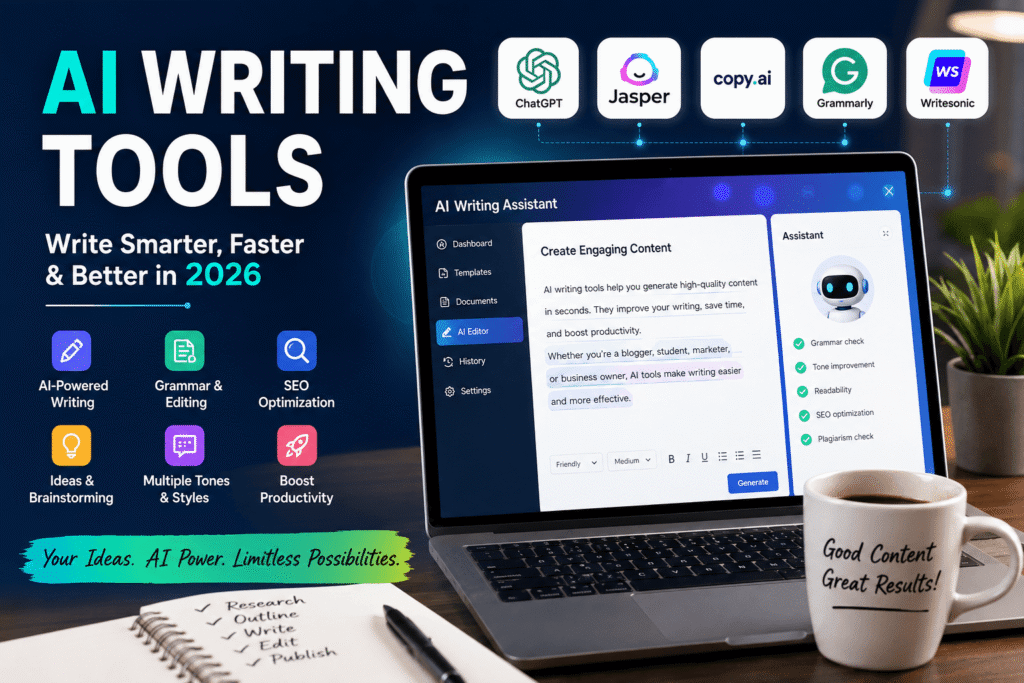

Writing has changed dramatically in recent years. From blog posts and business emails to social media captions and marketing campaigns, artificial intelligence is now helping people complete writing tasks faster and more efficiently. In 2026, AI writing tools have moved beyond simple text generation. Many can now help with brainstorming, research, outlining, rewriting, editing, tone adjustment, SEO optimization, and long-form content creation.
The biggest advantage is not simply producing words quickly. The real value comes from combining artificial intelligence with human creativity, experience, and judgment. When used correctly, these tools can reduce repetitive work while allowing writers to spend more time developing useful ideas and original perspectives.
What Are AI Writing Tools?
AI writing tools are software applications powered by artificial intelligence and large language models. They can understand written instructions and generate, improve, summarize, or reorganize text based on the user’s requirements.
A writer can provide a topic, audience, tone, format, or set of instructions, and the software can produce a starting point within seconds. Modern platforms can also rewrite existing material, expand short notes into detailed content, simplify complicated language, and adjust writing for different audiences.
The technology has developed considerably. Current platforms increasingly focus on workflow features such as brand voice, long-form consistency, editing, SEO support, and collaboration rather than simply generating paragraphs.
Why AI Writing Tools Are Becoming So Popular
One major reason for their popularity is speed. Creating an outline manually can take considerable time, especially when a writer is starting with a blank page. An AI assistant can suggest a structure almost instantly.
Another advantage is flexibility. The same type of technology can support a student preparing notes, a blogger planning an article, a marketer creating advertising copy, or a business owner writing customer emails.
Research and industry comparisons in 2026 show that the market has become more specialized. General-purpose assistants compete with dedicated platforms designed for marketing, SEO, grammar, editing, fiction, and business workflows.
Faster Content Production
Writers can use AI to create initial drafts, outlines, headlines, introductions, product descriptions, and other repetitive material. This can significantly reduce the time spent getting started.
Better Edi ting and Clarity
AI can identify awkward sentences, unnecessary repetition, grammatical mistakes, and unclear wording. Some tools can also change the tone from formal to conversational or from technical to beginner-friendly.
Support for Different Writing Styles
A modern writing assistant can adapt content for blogs, advertisements, emails, social media, reports, product pages, and other formats. This makes one technology useful across many professional environments.
Best AI Writing Tools for Different Needs
There is no single platform that is perfect for every writer. The best choice depends on the type of content being produced and the workflow a person needs.
ChatGPT for General Writing
ChatGPT is a versatile option for brainstorming, outlining, drafting, rewriting, summarizing, and developing ideas. It is particularly useful when a writer wants one assistant capable of handling several different writing tasks.
Claude for Long-Form Writing
Claude is often considered a strong option for longer and more nuanced writing. It can be useful for essays, detailed explanations, reports, and other projects where maintaining context and producing natural prose are important.
Grammarly for Editing
Grammarly focuses heavily on grammar, clarity, tone, and polishing. Rather than replacing a general writing assistant, it can work as an editing layer after a draft has been created.
Jasper for Marketing Content
Jasper is designed around marketing workflows and brand consistency. It can be particularly useful for businesses and teams that need content aligned with a defined brand voice.
Copy.ai for Business and Marketing
Copy.ai has developed beyond basic copy generation and is increasingly positioned around business and go-to-market workflows. It can help teams produce marketing and sales-related content at scale.
Sudowrite for Creative Writers
Sudowrite is designed specifically for fiction and creative writing. Writers working on stories and narrative projects may benefit from features created around creative development rather than conventional business copy.
Writesonic for SEO Content
Writesonic is increasingly focused on SEO and AI-search visibility as well as content generation. This makes it relevant for publishers and marketers who want their content to perform in modern search environments.
Important Features to Look For
Choosing software based only on its ability to generate text can be a mistake. A useful platform should fit the complete writing process.
Long-Form Content Generation
If you regularly write articles, guides, reports, or other lengthy material, look for tools that can maintain consistency throughout a document. Short prompts may produce impressive paragraphs, but long-form writing requires better organization and context management.
Tone and Brand Voice
Businesses often need consistent communication. A strong tool should allow users to control tone, terminology, style, and brand preferences. Brand voice has become one of the important differentiators among modern platforms.
SEO Assistance
For bloggers and publishers, SEO features can be valuable. Modern SEO-focused platforms can assist with content briefs, keyword placement, optimization, content refreshes, and search visibility.
However, SEO should never mean stuffing keywords into every paragraph. Search engines increasingly reward useful, relevant, and well-structured information.
Grammar and Readability
Editing capabilities can help remove unnecessary complexity and make content easier to understand. Grammar correction, readability suggestions, and tone adjustment are particularly useful when publishing professional material.
Integrations
A writing assistant becomes more useful when it fits naturally into an existing workflow. Browser extensions, document editors, content management systems, collaboration features, and other integrations can reduce the need to constantly move text between applications.
How to Use AI Writing Tools Effectively
The quality of the result depends heavily on the quality of the instructions.
Start With a Clear Prompt
Instead of asking an assistant to “write an article,” provide the topic, target audience, desired tone, structure, length, purpose, and important points.
For example, a detailed instruction might specify that the content should be educational, easy to read, organized with headings, and written for beginners.
Give the AI Useful Context
AI performs better when it understands the purpose behind the writing. Provide background information, customer details, product specifications, or research notes whenever possible.
Treat the First Draft as a Starting Point
A generated draft should not automatically become the final version. Review the information, remove unnecessary sections, add original insights, and make the language sound natural.
Fact-Check Important Information
AI systems can produce incorrect or outdated statements with confidence. Names, statistics, prices, technical specifications, medical information, financial claims, and other important facts should be independently checked before publication.
Benefits and Limitations
The biggest benefit is productivity. A writer can move from an empty page to a structured draft much faster.
These tools can also help overcome writer’s block. When someone has an idea but does not know how to organize it, AI can suggest different approaches.
However, there are limitations. Generated content may be repetitive, generic, inaccurate, or lacking in personal experience. Overusing AI can also make websites sound similar because many people rely on comparable prompts and patterns.
For this reason, human editing remains essential. Current industry guidance increasingly emphasizes using AI for structure, options, speed, and repetitive tasks rather than blindly publishing everything it generates.
AI Writing Tools for SEO in 2026
SEO content is changing because people now discover information through traditional search engines as well as AI-powered search and answer systems. Modern content strategies therefore need to focus on usefulness, credibility, clear organization, and search intent.
SEO-focused writing platforms can help create content briefs, identify related topics, optimize pages, and refresh older articles. Some tools are also beginning to consider visibility within AI-generated answers.
The best approach is to use AI for efficiency while adding original examples, firsthand knowledge, expert opinions, and useful information that readers cannot easily find elsewhere.
Who Should Use AI Writing Tools?
Bloggers can use them for research organization, outlines, drafts, and editing. Businesses can use them for emails, product descriptions, advertising copy, and internal documents.
Students may use them for brainstorming and understanding difficult concepts, while professional writers can use them to accelerate repetitive parts of their workflow.
Marketing teams can benefit from brand controls and content templates, whereas creative writers may prefer specialized tools built around storytelling.
The Future of AI Writing
The future is likely to focus less on simple text generation and more on intelligent writing workflows. Instead of producing an isolated paragraph, AI assistants are increasingly becoming part of research, planning, editing, optimization, and publishing processes.
The market is also becoming more specialized. General assistants remain powerful, while dedicated platforms provide additional features for specific industries and writing styles.
The most successful writers will probably not be those who allow AI to do everything. They will be the people who know which tasks to automate and which tasks require human creativity, judgment, and expertise.
Final Thoughts
AI writing tools have become valuable assistants for modern content creation. They can help writers brainstorm ideas, build outlines, produce drafts, improve clarity, adjust tone, and optimize content for different purposes.
Still, technology should support the writer rather than replace the writer. The strongest results come from a combination of intelligent software and human judgment. Choose a platform according to your specific needs, provide detailed instructions, verify important information, and always add your own perspective.
When used thoughtfully, AI can make writing faster without sacrificing the originality and usefulness that make great content valuable.