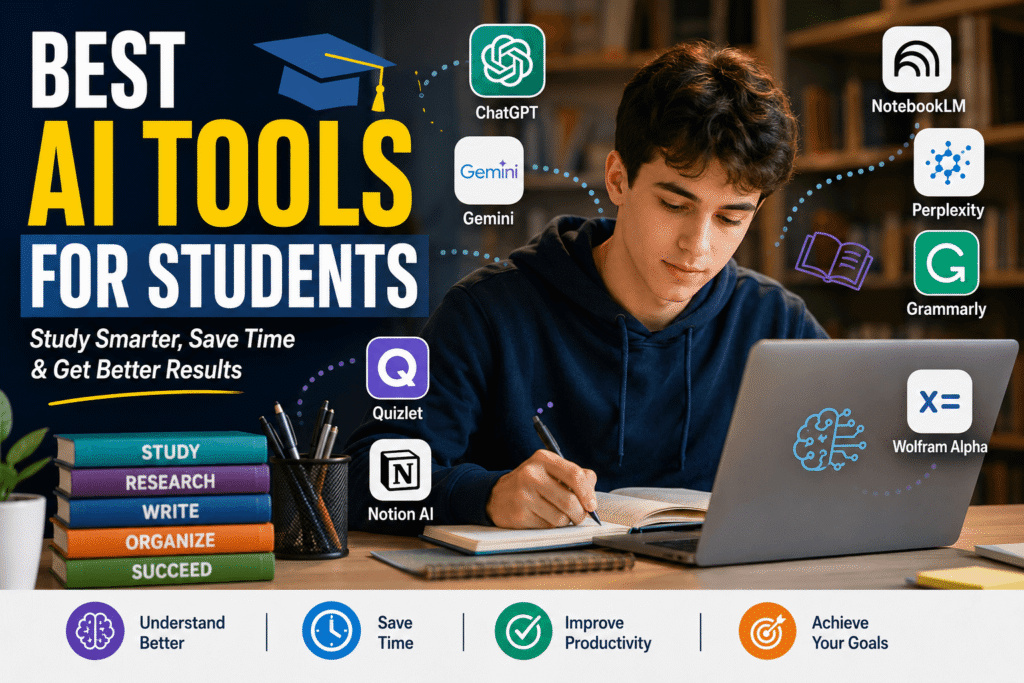

Artificial intelligence has changed the way students learn, research, write, and prepare for examinations. Instead of spending hours searching through textbooks or organizing notes manually, students can now use intelligent software to understand difficult subjects, summarize information, practice questions, and improve their productivity.
The growing popularity of AI Tools for Students does not mean traditional learning is becoming unnecessary. Instead, these technologies can work as learning assistants when used responsibly. The best tools help students understand concepts rather than simply providing answers.
Whether you are in school, college, university, or preparing for professional examinations, the right AI platform can save time and make studying more organized. This guide explores some of the most useful options available in 2026 and explains how students can use them effectively.
What Are AI Tools for Students?
AI-powered study tools are applications that use artificial intelligence to help with educational tasks. Depending on the platform, they can explain complicated topics, generate practice questions, summarize documents, improve writing, solve mathematical problems, create study schedules, or organize notes.
Unlike traditional educational software, modern AI systems can respond dynamically to questions and adapt explanations to different learning needs.
Why Are Students Using AI?
Students often have limited time and large amounts of information to understand. AI can help reduce repetitive work and provide immediate assistance when a teacher or tutor is unavailable.
Some common uses include:
- Understanding difficult concepts
- Creating study notes
- Summarizing lengthy documents
- Practicing examination questions
- Improving grammar and writing
- Conducting preliminary research
- Organizing assignments and projects
- Learning programming
- Creating revision plans
Best AI Tools for Students in 2026
There is no single tool that is perfect for every student. Different platforms are designed for different purposes, so choosing the right one depends on your subject, learning style, and academic goals.
1. ChatGPT for Learning and Homework Help
ChatGPT can act as an interactive study assistant. Students can ask it to explain complicated concepts in simple language, provide examples, generate practice questions, or help create a revision schedule.
One of its biggest advantages is flexibility. A student can request a beginner-level explanation and then ask for a more advanced version.
How Students Can Use ChatGPT
Instead of asking for a direct homework answer, students can ask for step-by-step explanations. This approach encourages understanding and makes the tool more useful for long-term learning.
2. Google Gemini for Research and Study
Google Gemini is another useful AI assistant for students. It can help brainstorm ideas, explain concepts, summarize information, and support various research-related tasks.
Students who already use Google’s productivity ecosystem may find it particularly convenient for organizing information and working with documents.
3. NotebookLM for Studying Documents
NotebookLM is designed around source material. Students can provide notes, documents, or other study resources and then interact with the information through questions and summaries.
This can be especially useful before examinations when students need to review a large collection of class materials.
Why NotebookLM Can Be Useful
Rather than asking an AI about a completely general topic, students can focus their questions on their own supplied materials. This makes it valuable for revision and document-based learning.
4. Perplexity for Research
Research can become difficult when students need to explore a topic from multiple perspectives. Perplexity is designed to provide conversational answers while emphasizing supporting sources.
It can help students discover information and identify areas that deserve further investigation.
However, students should always check important information against reliable academic sources before using it in an assignment.
5. Claude for Writing and Analysis
Claude can assist with writing, brainstorming, summarization, and analysis of lengthy material.
Students can use it to identify weaknesses in an essay, organize ideas, simplify complicated passages, or brainstorm possible research questions.
The best approach is to use AI-generated suggestions as a starting point rather than submitting automatically generated work.
AI Tools for Students for Writing
Writing is one of the most common academic tasks where AI can provide assistance.
Grammarly for Grammar and Editing
Grammarly can help students identify grammar, spelling, punctuation, and style problems. It can be particularly helpful for students writing essays, reports, applications, and presentations.
Students should still develop their own writing skills because editing software cannot replace good reasoning and clear communication.
QuillBot for Rewriting and Summarization
QuillBot is commonly used for paraphrasing, summarization, and writing assistance. It can help students experiment with different ways of expressing an idea.
However, paraphrasing tools should be used carefully. Students should understand the original information and avoid using automated rewriting to disguise copied material.
AI Tools for Mathematics and Science
Mathematics and science students often need more than a final answer. They need to understand how a problem is solved.
Wolfram Alpha for Mathematical Problems
Wolfram Alpha is useful for mathematical calculations, equations, statistics, and scientific problems. It can help students explore solutions and verify calculations.
The most effective method is to work through a problem independently first and then use an AI-powered calculator to check the result.
AI for Science Learning
AI assistants can also explain scientific theories, laboratory concepts, formulas, and technical terminology. Students can ask for analogies or simpler explanations when textbook language feels difficult.
AI Tools for Students for Note-Taking
Taking notes during lectures can be challenging, particularly when teachers speak quickly.
Otter.ai for Lecture Transcription
AI transcription services can convert spoken conversations and lectures into written text. This can make it easier to review material later.
Students should always follow their school’s or university’s rules before recording lectures, particularly when other people’s voices are involved.
Notion AI for Organizing Notes
Notion AI can help students organize information, summarize notes, brainstorm ideas, and structure projects.
For students managing several subjects simultaneously, an organized digital workspace can make revision considerably easier.
AI Tools for Students for Exam Preparation
Exam preparation is another area where AI can provide practical support.
Create Personalized Practice Questions
Students can ask an AI assistant to create multiple-choice questions, short-answer questions, or essay prompts based on a particular subject.
After completing the questions, students can review their mistakes and identify weak areas.
Build a Revision Schedule
An AI assistant can help create a study timetable based on examination dates, available study hours, and difficult subjects.
A useful schedule should include breaks, revision sessions, practice tests, and enough time for sleep.
Use AI as a Tutor, Not a Shortcut
The most important principle is to use AI to improve understanding. If a student simply copies an answer without learning the underlying concept, the technology has little educational value.
Benefits of Using AI for Education
The right technology can provide several advantages.
Faster Learning
Students can receive explanations quickly instead of spending a long time searching for basic information.
Personalized Explanations
AI can explain the same concept in multiple ways. A student can request examples, analogies, simpler vocabulary, or advanced explanations.
Better Organization
Digital assistants can help organize notes, tasks, research ideas, and study plans.
More Practice
Students can generate unlimited practice questions and use them for revision.
Limitations and Risks of AI in Education
Despite its advantages, AI is not perfect.
AI systems can sometimes produce inaccurate information, misunderstand questions, or provide outdated details. Students should verify important academic claims using textbooks, teachers, university resources, and trustworthy sources.
Academic integrity is another major concern. Schools and universities may have different policies regarding AI-generated content. Students should understand these rules before using AI for assignments.
Protect Your Personal Information
Students should avoid entering sensitive personal information, private academic records, passwords, or confidential documents into AI platforms unless they understand how that information is handled.
How to Choose the Right AI Study Tool
Before choosing an AI platform, consider what you actually need.
If your primary goal is conversational learning, an AI assistant may be useful. For research, a source-focused tool can be better. For mathematics, a specialized computational platform may provide stronger results.
Students should also consider:
- Accuracy
- Ease of use
- Cost
- Privacy
- Available features
- Compatibility with their devices
- School or university policies
Best Way to Use AI Tools for Students
AI becomes most valuable when combined with active learning.
First, try to understand the topic yourself. Then use AI to clarify difficult sections, create practice questions, or identify gaps in your knowledge. Finally, test yourself without AI to make sure you can reproduce the information independently.
This process turns artificial intelligence into a learning partner rather than a replacement for studying.
Final Thoughts
The best AI Tools for Students can make education more convenient, personalized, and productive. From conversational tutors and research assistants to writing editors, mathematical tools, transcription platforms, and digital note-taking systems, students now have many options.
However, technology should support genuine learning rather than replace it. Students who combine AI assistance with textbooks, teachers, critical thinking, practice, and independent research are more likely to benefit from these tools.
In 2026, the real advantage is not simply having access to artificial intelligence. It is knowing how to use AI responsibly and effectively. When used as a study assistant instead of a shortcut, AI can help students save time, understand challenging subjects, and become more confident learners.
Frequently Asked Questions
Are AI tools useful for students?
Yes. They can help with explanations, research, writing, revision, organization, mathematics, and practice. Their effectiveness depends on how responsibly they are used.
Can students use AI for homework?
Students can use AI for learning and guidance, but they should follow their school’s or university’s academic policies. Understanding the solution is more valuable than simply copying an answer.
Which AI tool is best for studying?
There is no universal best option. General AI assistants are useful for explanations, while specialized platforms may be better for research, mathematics, writing, or note-taking.
Are AI study tools free?
Some provide free versions, while others offer premium features through paid plans. Features and limits can vary over time.
Can AI replace teachers?
No. AI can provide explanations and practice, but teachers offer human judgment, feedback, classroom interaction, mentorship, and subject-specific guidance that AI cannot fully replace.