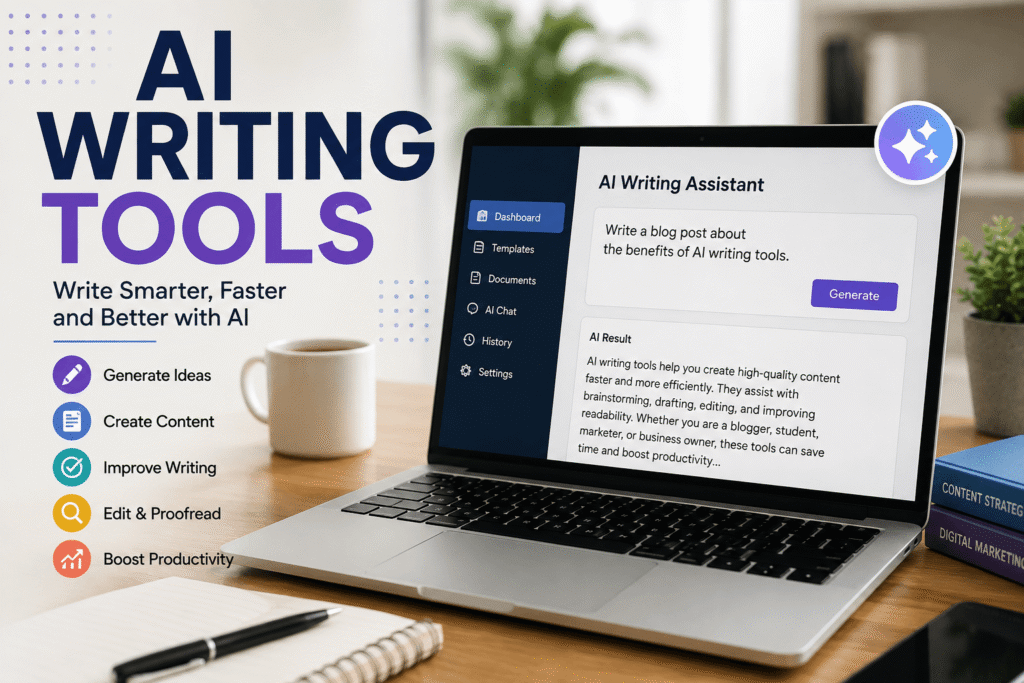

Artificial intelligence has changed the way people create content. From blog posts and product descriptions to emails, social media captions, and marketing campaigns, AI can help writers complete tasks faster while maintaining a consistent writing style. In 2026, AI Writing Tools have become useful assistants for students, bloggers, marketers, business owners, freelancers, and professional writers.
These platforms are not designed to replace human creativity. Instead, they can help users overcome writer’s block, organize ideas, improve grammar, research topics, and produce first drafts. The best results usually come when AI is combined with human experience, editing, fact-checking, and originality.
This guide explores the most important features of modern AI writing software, how these tools work, their advantages and disadvantages, and how to choose the right solution for your needs.
What Are AI Writing Tools?
AI Writing Tools are software applications that use artificial intelligence and natural language processing to generate, rewrite, summarize, edit, or improve written content. They can understand instructions and produce text based on a user’s prompt, topic, audience, tone, and desired format.
Some platforms specialize in long-form articles, while others are designed for grammar correction, advertising copy, academic assistance, or business communication.
How AI Writing Technology Works
Most modern writing assistants rely on large language models trained on enormous amounts of text. When a user provides a prompt, the system analyzes the words and context before predicting and generating an appropriate response.
For example, a user could ask an AI tool to create a blog outline about digital marketing. The system may generate a title, introduction, headings, subheadings, and key points that can later be reviewed and expanded by the writer.
The technology can also analyze existing content and suggest improvements in readability, sentence structure, tone, and vocabulary.
Why AI Writing Tools Are Becoming Popular
The biggest reason for their popularity is efficiency. Creating high-quality content manually can take hours, especially when research, outlining, editing, and optimization are involved.
AI can speed up several parts of the process.
Faster Content Creation
Writers can generate ideas and initial drafts within minutes. This is particularly useful for people who publish frequently.
Better Organization
AI assistants can turn a broad subject into a structured outline. This makes it easier to develop an article logically and avoid unnecessary repetition.
Help With Writer’s Block
Even experienced writers sometimes struggle to find the right starting point. AI can provide topic ideas, headlines, questions, and opening paragraphs that help get the creative process moving.
Editing and Rewriting
AI can identify awkward sentences and suggest clearer alternatives. It can also rewrite content in a professional, conversational, persuasive, or simplified tone.
Best AI Writing Tools for Different Needs
There is no single platform that is perfect for everyone. The right choice depends on what you want to accomplish.
1. ChatGPT for Versatile Writing
ChatGPT is one of the most flexible AI assistants available. It can help with brainstorming, outlines, articles, emails, scripts, summaries, social media content, and many other writing tasks.
Its biggest advantage is versatility. Users can provide detailed instructions about tone, audience, length, structure, and formatting.
Best For
- Blog ideas
- Long-form drafts
- Brainstorming
- Emails
- Social media content
- Content rewriting
- Research assistance
2. Claude for Natural-Sounding Content
Claude is known for handling long instructions and producing polished, readable responses. It can be useful when writers need help organizing large amounts of information or improving existing drafts.
Its conversational approach can also make it useful for refining ideas through multiple rounds of editing.
Best For
- Long documents
- Editing
- Brainstorming
- Professional writing
- Detailed content development
3. Grammarly for Editing and Grammar
Grammarly focuses heavily on improving written communication. It can detect grammar problems, spelling mistakes, punctuation issues, and style concerns.
For writers who already create their own content but want an additional editing layer, this type of tool can be extremely useful.
Best For
- Grammar checking
- Proofreading
- Professional emails
- Business communication
- Improving clarity
4. Jasper for Marketing Content
Jasper is designed primarily around marketing and business content. It can assist marketers with advertisements, campaign ideas, website copy, product messaging, and other promotional materials.
Businesses that publish content regularly may benefit from specialized workflows and brand-focused features.
Best For
- Marketing copy
- Advertising
- Brand content
- Campaigns
- Business writing
5. Copy.ai for Business Content
Copy.ai focuses on marketing and sales-related content. It can help businesses generate promotional copy, product messaging, emails, and other materials.
Its usefulness increases when teams need to create multiple variations of similar content while maintaining a consistent communication style.
Best For
- Sales copy
- Marketing
- Product descriptions
- Business emails
- Promotional content
AI Writing Tools for SEO Content
Search engine optimization is another area where AI can support writers. These platforms can help generate topic ideas, create outlines, identify related concepts, and improve content structure.
However, simply generating an article with AI does not guarantee high search rankings.
Creating Helpful SEO Content
Successful SEO content should answer the reader’s question clearly and provide genuine value. Writers should understand search intent before creating an article.
For example, someone searching for “best web hosting” may want comparisons, features, pricing considerations, performance information, and recommendations. A basic definition would not fully satisfy that search intent.
AI can help organize these requirements, but the writer remains responsible for accuracy and usefulness.
Using Keywords Naturally
Keywords should appear naturally throughout an article. Repeating the same phrase excessively can make content difficult to read and may create a poor experience for visitors.
A better strategy is to use related terms, questions, synonyms, and topic-specific vocabulary while keeping the primary keyword relevant to the content.
AI Writing Tools for Students
Students can also benefit from AI writing technology when it is used responsibly.
AI can help explain complicated concepts, create study questions, organize notes, improve grammar, and provide feedback on drafts.
Responsible Academic Use
Students should avoid submitting AI-generated material as entirely their own work when academic rules prohibit it. Instead, AI can be treated as a learning assistant.
For example, a student can write an essay independently and then use an AI assistant to identify unclear sentences or organizational problems.
This approach supports learning while keeping the student’s own ideas and judgment at the center.
Benefits of AI Writing Tools
There are several important advantages to using AI as part of a writing workflow.
Saves Time
AI can handle repetitive writing tasks quickly, allowing users to spend more time on strategy and creativity.
Generates Ideas
When users do not know what to write about, AI can produce topic ideas, questions, headlines, and content angles.
Improves Productivity
Freelancers and businesses can manage larger content workloads with the assistance of automated drafting and editing.
Supports Multiple Writing Styles
Many tools can adapt content for different audiences and tones, including professional, friendly, persuasive, educational, and conversational styles.
Helps Non-Native English Writers
People who understand English but struggle with grammar or sentence structure can use AI to make their writing clearer and more natural.
Limitations of AI Writing Tools
Despite their advantages, these technologies have important limitations.
Accuracy Problems
AI can sometimes produce incorrect facts, outdated information, or unsupported claims. Important information should always be verified.
Repetitive Writing
Poorly instructed AI systems may produce generic phrases and predictable structures. Human editing is essential for making content distinctive.
Lack of Personal Experience
AI does not automatically possess the personal experiences, opinions, or firsthand expertise that can make an article valuable.
Overdependence Can Reduce Creativity
If writers rely entirely on automated generation, they may spend less time developing their own ideas and writing skills.
How to Choose the Right AI Writing Tool
Choosing the right platform starts with identifying your main goal.
For Bloggers
Look for tools that support brainstorming, outlines, long-form drafting, editing, and SEO planning.
For Businesses
Marketing-focused platforms may be more useful because they can support advertisements, sales copy, product descriptions, and brand messaging.
For Students
Choose a tool that emphasizes explanations, editing, summarization, and learning support rather than simply generating complete assignments.
For Professional Writers
Advanced editing, customization, document handling, and control over tone may be more important than automatic content generation.
How to Use AI Writing Tools Effectively
The quality of the output depends heavily on the quality of the instructions.
Give Clear Prompts
Instead of saying “write an article about technology,” provide details about the target audience, purpose, tone, structure, and important points.
Add Human Experience
Include your own examples, observations, opinions, and expertise. These elements can make content more authentic.
Fact-Check Important Claims
Always verify statistics, dates, names, product information, and other factual claims before publishing.
Edit Before Publishing
Never assume the first AI-generated draft is ready for publication. Read it carefully, remove unnecessary sections, improve transitions, and make the language sound natural.
The Future of AI Writing Tools
AI writing technology will likely become more specialized and personalized. Future platforms may provide stronger brand controls, better factual verification, improved research capabilities, and more sophisticated editing.
Instead of simply generating text, writing assistants are increasingly becoming complete content partners that can help users move from an initial idea to a finished publication.
Human creativity, however, will remain important. Original ideas, expertise, judgment, storytelling, and personal experience are difficult to replace with automation alone.
Final Thoughts on AI Writing Tools
AI Writing Tools have become valuable assistants for modern content creation. They can save time, generate ideas, improve grammar, organize information, and support writers across many industries.
The most effective approach is not to let AI do everything. Instead, use it to handle repetitive tasks and accelerate the early stages of writing while keeping human creativity, fact-checking, and editing at the center of the process.
Whether you are a blogger, student, marketer, freelancer, or business owner, the right AI assistant can make your writing workflow faster and more productive. The key is choosing a platform that matches your goals and using it as a smart assistant rather than a complete replacement for human judgment.